Quick commerce rewards clarity, not chaos.
Whether you’re launching on Blinkit or Instamart, the first 30 days determine whether you build a stable growth engine — or enter a cycle of inconsistent performance.
Before diving into the ramp plan, it’s important to understand how these platforms behave differently.
Table of Contents
Blinkit Ads vs Instamart Ads: Advertising Reality Check
| Parameter | Blinkit | Instamart |
| User Intent | High urgency, utility-driven | Mix of urgency + discovery |
| Shelf Space | Tighter, faster scroll | Slightly broader browsing |
| Creative Impact | Immediate clarity required | Slightly more room for persuasion |
| Geo Sensitivity | Extremely dark-store dependent | Strong city-cluster impact |
| Scaling Pattern | Depth-first (strong zones) | Cluster-first (city grouping) |
| SKU Strategy | 3–5 hero SKUs dominate | Wider testing possible but controlled |
Deep Dive in detail about Getting Started with Blinkit Ads
What This Means?
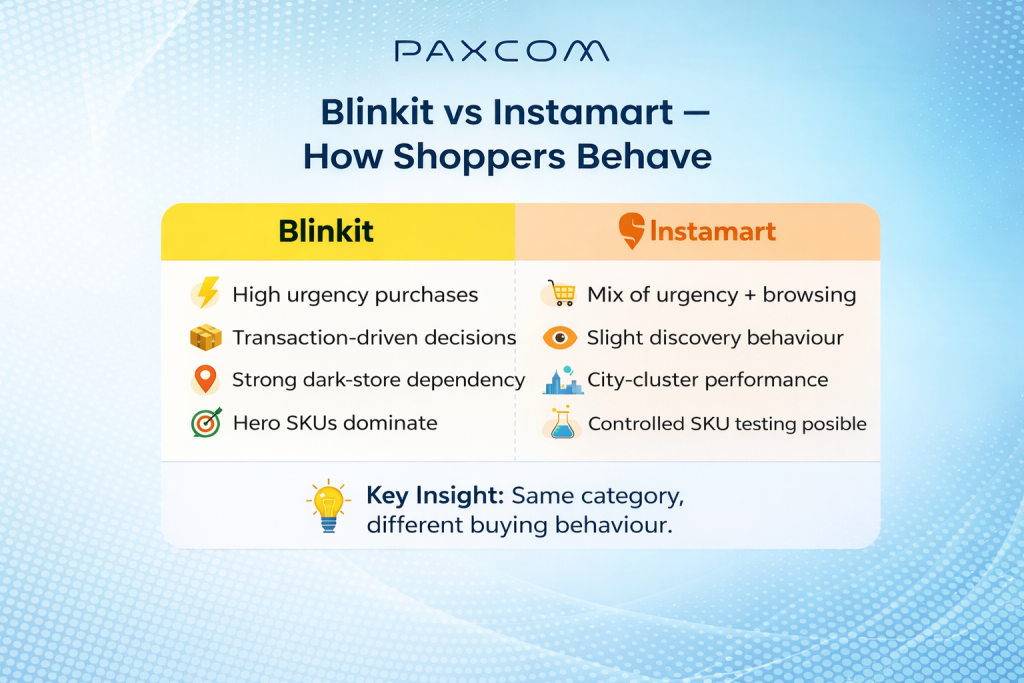
On Blinkit, decisions are transactional and fast. The shopper usually knows what they want. Visibility and pack clarity matter more than storytelling.
On Instamart, there is slightly more room for browsing behavior. However, speed still defines performance. If your SKU doesn’t communicate instantly, it loses.
Understanding this distinction helps shape your first-month strategy.
The First 30 Days Structured Ramp Plan For Blinkit Ads Vs Instamart Ads
Phase 1 (Days 1–7): Foundation and Signal Collection
The first week is not about aggressive revenue generation. It is about structured entry.
Focus on:
- Selecting 3–5 high-velocity SKUs
- Validating dark store and regional stock coverage
- Ensuring PDP readiness (clear primary image, price alignment, correct pack visibility)
- Setting clean campaign segmentation by SKU and geography
At this stage, your objective is to collect clean data signals. If stock depth is inconsistent, scaling will distort performance from day one.
Phase 2 (Days 8–14): Learning Without Panic
By the second week, performance patterns begin to emerge.
Instead of scaling impulsively, analyze:
- SKU-level conversion rates
- Region-level performance differences
- Cost-per-order consistency
- Click-through vs conversion gap
- Stock-driven performance dips
Many brands misread early data because they ignore availability volatility. A SKU might show strong click-through but weak conversion simply because certain dark stores are running low on inventory.
Week 2 is about diagnosing friction.
Phase 3 (Days 15–21): Controlled Scaling
Once winning SKUs and regions are identified, scaling becomes safer — but only if availability is stable.
Scale based on:
- Stable stock coverage
- Predictable cost efficiency
- Clear geo-level performance strength
- Ranking improvement within category
Avoid launching multiple new SKUs at this stage. Depth in high-performing zones generates more consistent returns than spreading budgets thin.
Phase 4 (Days 22–30): Efficiency and Structure
In the final stretch of your first month, optimization replaces experimentation.
This includes:
- Pausing low-performing SKUs
- Refreshing creatives where click-through drops
- Reallocating budgets toward top-performing geos
- Aligning stock buffers with increased demand
- Reviewing media-to-inventory alignment
By Day 30, you should have a repeatable performance blueprint — not just revenue numbers.
Creative & PDP Requirements: Where Most Brands Fail?
Quick commerce is scroll-led and speed-driven.
Blinkit Ads vs Instamart Ads: Creative Expectations
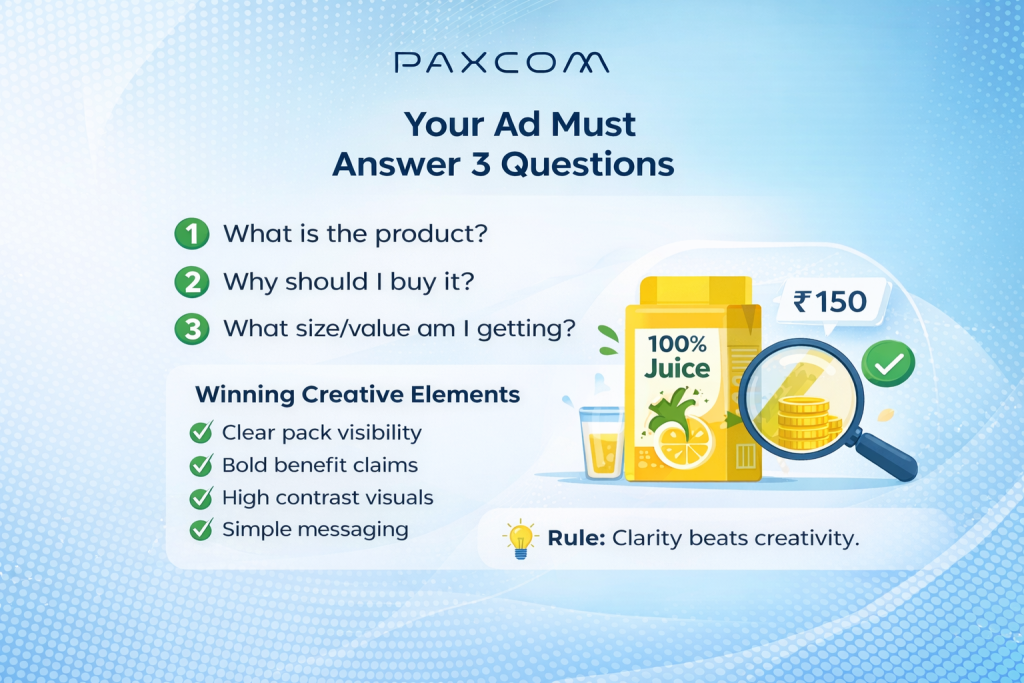
Your creative must answer three questions instantly:
- What is it?
- Why should I buy it?
- What size/value am I getting?
Large, readable benefit claims outperform subtle messaging. High-contrast visuals convert better than lifestyle-heavy creatives. Clarity beats design complexity.
Blinkit Ads vs Instamart Ads: PDP Expectations
PDPs must reduce hesitation.
The first image should clearly show:
- Pack size
- Key benefit
- Category relevance
Titles must support discoverability. Claims in ads must match PDP content exactly. Even small inconsistencies reduce conversion in fast-checkout environments.
Common First-Month Mistakes (And What to Do Instead): Blinkit Ads vs Instamart Ads
| Mistake | What Happens | What to Do Instead |
| Scaling too early | Media inefficiency increases | Scale only stable SKUs |
| Launching too many SKUs | Budget dilution | Focus on hero SKUs first |
| Ignoring dark store coverage | Conversion inconsistency | Validate geo-stock alignment |
| Treating it like Amazon | Overloaded PDPs | Prioritize instant clarity |
| No budget reallocation rule | Random spend movement | Define scaling thresholds |
Quick commerce punishes randomness. It rewards disciplined execution.
Blinkit Ads vs Instamart Ads: The “First 10 Campaigns” Validation Framework
Before declaring your launch successful, ensure your first 10 campaigns validate:
- SKU-level clarity
- Region-level strength
- Stable stock depth
- Conversion benchmark
- Cost efficiency threshold
- Creative testing learnings
- Budget reallocation rule
- Media-to-stock alignment
- Ranking improvement tracking
- Repeatability of performance
Without this validation, early growth can be misleading.
Why Structure Beats Speed?
Quick commerce does not reward the biggest budget. It rewards the most stable system.
Brands that win:
- Align inventory with campaign intensity
- Focus on hero SKUs
- Scale by geography discipline
- Optimize from data, not impulse
The first 30 days are not about domination.
They are about building a foundation that can scale predictably.
Request a Starter Media Plan
If you’re confused with Blinkit Ads vs Instamart Ads or trying to fix early volatility, start with structure.
Paxcom’s Starter Media Plan is designed to align SKU selection, geo-priority mapping, inventory stability, creative readiness, and campaign architecture into a disciplined 30-day ramp.
Instead of reacting to inconsistent performance, you begin with a clear roadmap built for signal, learning, and scalable growth.
Request a starter media plan and build your quick commerce presence on clarity — not guesswork.
People Also Ask